

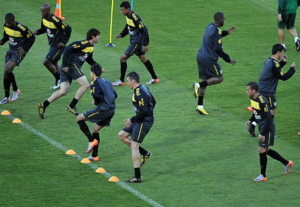
Plenty of players work hard and still go nowhere. Not because they lack talent — some of them have loads of it. It usually comes down to how they train and, honestly, whether what they’re doing in sessions is actually connected to what the game asks of them. Professional soccer training closes that gap in ways most players don’t expect.
Your Weaker Foot Costs You More Than You Think
Nobody likes admitting this, but defenders already know which foot you favour. They knew before the match started. A defender doesn’t wait to see what you do — they read your body shape and push you onto the side they want you on. So while most players accept their weak foot as a permanent flaw, the better academies treat it as a solvable problem. Sessions deliberately force the weaker foot until using it stops being a conscious decision. Once that happens, defenders suddenly have no safe side to give you. That half-second of doubt they carry is genuinely useful.
Speed Training Gets It Backwards
Fitness and match speed are not the same thing, though plenty of programmes treat them like they are. The sprints that matter in a game — the ones that win the ball or lose it — happen from a dead stop, off a slow jog, out of a turn. Professional soccer training works on that specific kind of acceleration, the first two or three steps, the hip angle, the weight transfer. Distance running builds a good engine. It doesn’t build the burst that gets a player to the ball a fraction ahead of someone else.
Pressing Without Triggers Is Just Running
Watch a team press poorly and it looks chaotic — players sprinting at the ball with no real plan. The opposition plays through it easily because there’s no coordination, just energy. Good pressing isn’t about intensity, it’s about timing. Everyone reading the same cue at the same moment — a misplaced pass, a keeper with the ball, a slow touch — and moving as a unit. That coordination gets drilled into players through structured sessions until it becomes second nature. The result isn’t pressure, it’s a trap. Very different to deal with.
Recovery Is Training Too
Hard sessions back to back without proper rest don’t make players tougher — they make them slower and more prone to injury. The body adapts during recovery, not during the session itself. Coaches who understand this build recovery days into the programme on purpose, treating them as seriously as any physical session. Players who come into a session properly rested do better work. It’s a simple idea that gets skipped constantly in favour of just doing more.
The Brain Slows Down When the Body Is Tired
Late in a close match, players start making decisions they’d never make when fresh — rushed passes, poor positioning, switching off at the wrong second. Professional soccer training trains for this directly by putting decision-heavy drills near the end of physically exhausting sessions. It forces the brain to stay sharp when everything else is telling it to switch off. Players who’ve never trained this way tend to hold up well for most of the match and then fall apart exactly when they need to be at their best.
Set Pieces Are Rarely Taken Seriously
Most teams spend barely any time on set pieces, then act surprised when they concede from a corner or can’t convert one. The movements involved — who goes near post, who peels away, who blocks — are not complicated, but they require repetition to work under match pressure. Programmes that actually carve out proper time for this give players a reliable way to manufacture chances that doesn’t depend on outplaying the opposition in open play. It’s one of the most underused advantages in the game.
Confidence Comes From Doing, Not Thinking
Players talk about confidence like it’s a mood — something that shows up on good days and disappears on bad ones. In practice it’s much simpler than that. When a skill has been drilled enough times in enough different situations, the player stops thinking about it. The hesitation goes away because the body already knows what to do. That’s not mental strength, it’s just repetition. Structured training creates the conditions for that repetition to actually happen, with feedback, at the right intensity.
Position-Specific Training Closes the Real Gaps
A winger and a defensive midfielder don’t need the same training session. Generic fitness work gets everyone fitter in general terms, but the specific moments that define each position — when to hold the line, when to make the run, when to press and when to sit — those don’t come from general drills. Position-specific work targets exactly those decisions, repeatedly, until the player handles them without hesitation. That’s the kind of improvement that shows up in matches and doesn’t come from anywhere else.
Conclusion
The players who improve quickest aren’t always the most naturally gifted. What they tend to share is access to training that’s actually built around what the game demands — not generic fitness, not aimless repetition, but work with a clear purpose behind it. Professional soccer training does that. It looks at where a player’s game breaks down and builds sessions around fixing it. For anyone serious about improving, that structure makes all the difference.